NSF AI-Ready Testbed for Tropical Cyclones: Planning the Expansion of NOAA’s Hurricane and Ocean Testbed
Bridging Artificial Intelligence Research and Operational Hurricane Forecasting
NSF Award: IIS-2509835
PI: Kate Musgrave | Co-PI: Imme Ebert-Uphoff
Colorado State University – Cooperative Institute for Research in the Atmosphere (CIRA)
August 15, 2025 – July 31, 2027
Background
- The National Oceanic and Atmospheric Administration (NOAA) established the
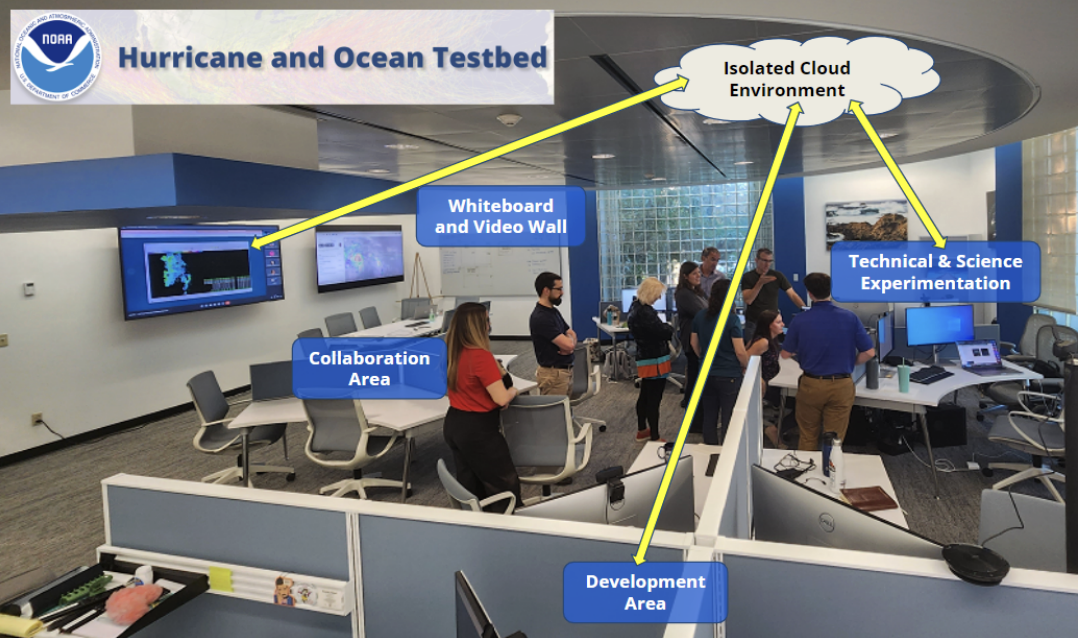
Hurricane and Ocean Testbed (HOT) in 2021. - HOT was developed to test new models and products to improve hurricane forecasts, but it was not designed to handle artificial intelligence (AI) models.
- This creates a disconnect between AI researchers developing promising models and the operational community that could benefit from them.
Project Objectives
Plan the expansion of NOAA’s Hurricane and Ocean Testbed so artificial intelligence models can be evaluated using operational forecasting standards, workflows, and metrics.
Connect AI researchers with operational hurricane forecasters to align scientific innovation with real-world forecasting needs, constraints, and decision-making processes.
Advance hurricane prediction capability in support of public safety and resilience, consistent with NSF’s mission to promote national health, prosperity, and welfare.
Project Team
Interdisciplinary research team with expertise in hurricanes, artificial intelligence,
risk communication, and research-to-operations transitions.
Colorado State University – Cooperative Institute for Research in the Atmosphere (CIRA)
- Kate Musgrave (Principal Investigator)
- Imme Ebert-Uphoff (Co-Principal Investigator)
- Mark DeMaria
- Alan Brammer
- Jonathan Martinez
National Center for Atmospheric Research (NCAR)
NOAA – National Hurricane Center (NHC) / Hurricane and Ocean Testbed
Core Activities
The project is organized around two complementary activities that together support the planning and design of an AI-ready expansion of NOAA’s Hurricane and Ocean Testbed.
Enable guest AI researchers to evaluate models within NOAA’s Hurricane and Ocean Testbed using operational workflows and standards.
- Invite guest AI researchers and serve as the liaison to the testbed.
- Develop a tiered test protocol for AI models.
- Identify AI infrastructure needs for expansion.
- Extract insights from model performance.
Convene stakeholders to define requirements and produce a practical plan for expanding HOT into an AI-ready testbed.
- Conduct meetings with testbed users and operational partners.
- Hold a workshop to design an AI-ready expansion framework.
- Develop an expansion plan and implementation roadmap.
- Assess which elements generalize to other testbeds.
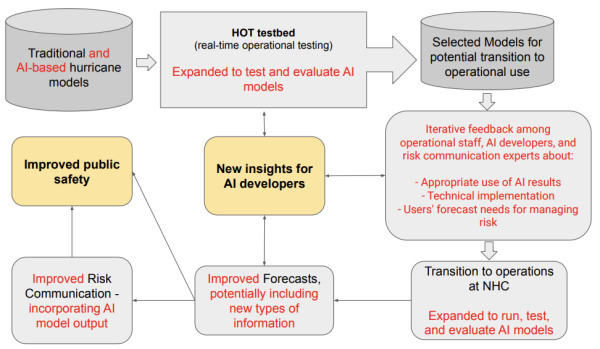
Changes and activities needed to expand the HOT are shown in red.
Highlights & Impact
This project is already contributing to advances in AI-enabled tropical cyclone forecasting through collaborations, peer-reviewed research, and public engagement.
Our team is collaborating with Google DeepMind to improve tropical cyclone forecasts using artificial intelligence.
Our team evaluated artificial intelligence weather prediction (AIWP) models for tropical cyclones using operational forecasting standards.
Partners & Sponsors
Partners:

Funding Sponsor: