
Celebrating 45 years of CSU’s Cooperative Institute for Research in the Atmosphere
By Theresa Barosh | Sept. 2025 | Originally posted in SOURCE
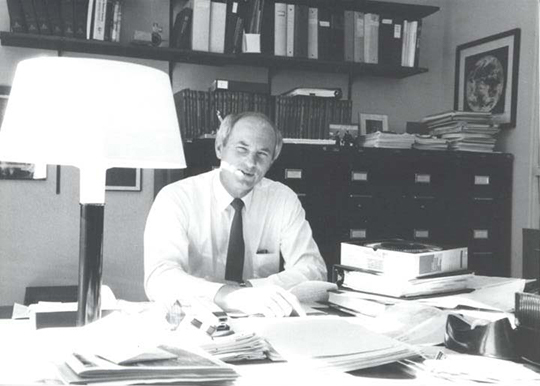
On Sept. 12, 1980, the president of Colorado State University signed the cooperative agreement with NOAA that resulted in the Cooperative Institute for Research in the Atmosphere (CIRA). The founding director of CIRA, Thomas Vonder Haar, had been at the university’s Department of Atmospheric Science for about a decade before that.
Now, 45 years later, CIRA is recognized as an authority in weather satellite data – developing systems and tools that simplify the acquisition and manipulation of satellite and model data for scientific research.
“Faculty and students at CSU already had nearly two decades of collaboration with NOAA researchers and forecasters. The Department and its CSU associates had been recognized as among the leaders of research and graduate education in the US,” said Vonder Haar, an emeritus University Distinguished Professor. “However, joint activities were not easy to arrange. A much better arrangement for cooperation was needed.”
CIRA is now one of only 16 NOAA cooperative institutes.
“The Cooperative Institutes play a key role in realizing NOAA’s mission goals of benefiting society,” said current CIRA Director Steven Miller, who is also a professor in the Department of Atmospheric Science.
NOAA works to understand and predict changes to impactful weather, the ocean, and the health of food-producing coastal ecosystems to benefit society.
“CIRA researchers translate scientific knowledge into actionable tools,” Miller said, “helping NOAA’s National Weather Service forecasters to understand and better predict the rapidly evolving weather situation. This also enables forecasters to issue the accurate, reliable, and time-critical watches and warnings that safeguard the lives and property of everyday people.”
Based in the Walter Scott, Jr. College of Engineering, CIRA researchers connect academic research to operational weather forecasting. CIRA also supports a broad spectrum of NOAA research, including forecast model improvements, hurricane track and intensity forecasting, aviation weather forecasting, societal and economic benefits of weather information, and forecaster training on the use of satellite observations.
To celebrate 45 years of CIRA, here are 10 things you might not know:
To celebrate 45 years of CIRA, here are 10 things you might not know:
- Vonder Haar founded CIRA in 1980 and directed it for 28 years, followed by Emeritus University Distinguished Professor Graeme Stephens and Professor Christian Kummerow. Professor Steven Miller has served as CIRA’s director since 2021.
- CIRA is based on the CSU Foothills Campus with the Department of Atmospheric Science, a close collaborator. Embedded in this academic environment, CIRA has supported hundreds of student researchers with funding, mentoring, making data available and providing useful tools.
- CIRA operates a Geostationary Operational Environmental Satellite Earth Station—an array of large satellite dishes that provide real-time downlink of satellite information.
- CIRA processes data into valuable weather imagery and products for forecasters.
Some of the nation’s preeminent hurricane researchers work at CIRA and Atmospheric Science in the land-locked State of Colorado because this is where Herbert Riehl, the founder of Atmospheric Science, chose to host his research - CIRA works with federal partners beyond NOAA, including NASA, the U.S. Department of Defense and the National Park Service, and helps these partners work with one another.
- In 2007, NASA honored CIRA with a Public Service Group Achievement Award for processing data to get NASA’s CloudSat mission information about the characteristics of clouds to the international science community.
- CIRA has hosted a program called Interagency Monitoring of Protected Visual Environments, also known as IMPROVE, for 40 years in collaboration with the National Park Service and the Environmental Protection Agency, monitoring air quality to protect the scenic vistas of the country’s most pristine locations.
- CIRA researchers are leading the charge on cutting-edge AI for forecasting and research and have even evaluated GOOGLE AI products.
- Several federal employees have offices at CIRA, supporting collaboration and coordination. About half of CIRA’s staff are deployed to federal labs across the country.
- Since its inception in August 2022, CIRA’s satellite imagery libary has been used widely for public engagement and by the media to cover major weather events.